

Search for a chemical and you’ll sometimes find the wrong label stuck to it. Plenty of students type hcl base when they’re trying to work out how hydrochloric acid behaves, so let’s settle it first. HCl isn’t a base. It’s a strong acid, and one of the best examples you could choose for learning what an acid actually does.
What makes it an acid
The Brønsted–Lowry definition is short. An acid gives away a proton, and a base accepts one. A proton here is a hydrogen atom that has lost its electron, H+.
Put hydrogen chloride into water and it hands its proton to a water molecule. You end up with hydronium, H3O+, and chloride, Cl−. Written out:
HCl + H2O → H3O+ + Cl−
HCl gave the proton, so it’s the acid. Water took it, so in this reaction water is the base. That may be where some of the mix-up starts, because there is a base in the equation. It just isn’t the HCl.
Why we call it strong
“Strong” doesn’t mean dangerous or concentrated. It tells you how completely the acid breaks up in water. Virtually every HCl molecule in an ordinary dilute solution passes its proton on. Hardly any are left whole.
Acetic acid, the sour part of vinegar, is weak. In a 0.1 molar solution only about one molecule in a hundred has given up its proton at any moment. The same amount of HCl gives a pH of about 1, while the acetic acid sits nearer 2.9. Each step on the pH scale is a factor of ten, so that gap is bigger than it looks.
Then where’s the base?
Every acid has a conjugate base, which is what remains after the proton leaves. For HCl that’s chloride. In theory Cl− could take a proton back. In water it practically never does, and chemists describe it as a negligible base.
There’s a handy pattern in this. The stronger the acid, the weaker its conjugate base. It explains why table salt, which is full of chloride, doesn’t make water basic. A spoonful of it in a glass leaves the pH more or less where it was.
Seeing it in action
Add HCl to sodium hydroxide and the two cancel each other. The products are salt and water:
HCl + NaOH → NaCl + H2O
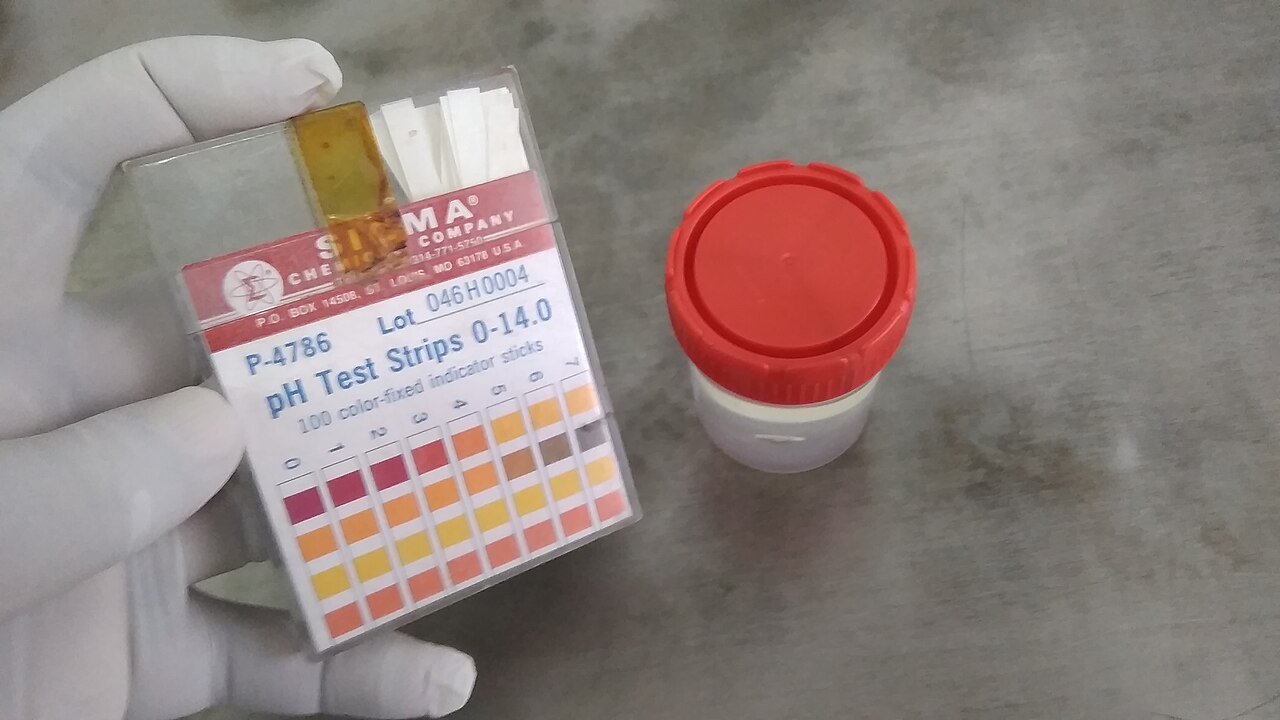
Drop some on baking soda and it fizzes with carbon dioxide. Put a piece of magnesium ribbon in it and you’ll get bubbles of hydrogen. Touch blue litmus paper to it and the paper turns red. All of these are things that acids do.
You carry some with you, too. Your stomach makes hydrochloric acid to help break down protein and kill germs, and its pH usually falls somewhere between 1.5 and 3.5. When it irritates you, the antacid you take is a base.
The OH trap
Many learners look for OH to spot a base, and that works for NaOH or KOH. It fails elsewhere. Ammonia, NH3, has no OH but is a base. Ethanol has an OH and isn’t a base in any useful everyday sense. Looking for H at the front is a better clue for simple acids, such as HCl, HBr and HNO3, although it won’t carry you through every case.
Asking what the substance does with protons is safer than judging it by its letters.
Handling it
Concentrated hydrochloric acid gives off sharp fumes and burns skin and eyes. Wear goggles and gloves, work with good ventilation, and add acid to water rather than the other way around. Never mix it with bleach, since that releases poisonous chlorine gas.
The short version
HCl donates protons, donates nearly all of them, and leaves behind a chloride ion that doesn’t want them back. That’s a strong acid from start to finish. If you’ve got a list of other compounds to sort, compairro.com covers many of the usual ones. Write the reaction with water first, and the label normally follows.
